
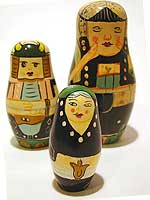
Sometimes the hardest part of building a character is coming up with a good name. You can always take a name from Tolkien or other fantasy novels, but you’ve seen those names over and over and you want something a little different, but not way out there. How about an historical name? Or one from a different culture? In the first “Beyond ‘Fred'” post, I covered Roman names. If Roman names aren’t your cup of tea, how about Russian ones?
[Photo courtesy of: http://www.flickr.com/photos/aussiegall/ / CC BY 2.0]
Russian Name Structure
Russian names are complex, as many people have not only a given name but also several nicknames, based on the their relationship with the speaker. Because of this, I’m using a very simplified Russian naming method.
In general, Russian names consist of two elements: a given name and a patronymic. Russian patronymic names are based on the father’s given name, with a ending that depends on the character’s sex:
-ov for a man, -ova for woman
So Boris, son of Ivan would be Boris Ivanov. Ivan’s daughter Susan would be Susan Ivanova. Women usually retain their own last names, even after they’re married. There is an exception to this — if the person is a member of the ruling class, the ending is different:
-vitch for a man, -vitcha for a woman.
If the father’s name ends in a consonant, add the ending becomes -ovitch or -ovitcha. So Boris, the son of Ivan who’s a prince would be Boris Ivanovitch and Susan would be Ivanovitcha.
For a really good, in depth coverage of creating a Russian patronymic, see Paul Goldschidt’s Dictionary of Russian Names — Grammer.
List of Names
This also includes nicknames based on the given names, where I know them.
Male Names
- Alexandr (Sasha, Shurik, Alex)
- Alexei
- Arkady
- Boris
- Budimir
- Busla
- Dmitri (Dima, Dimka)
- Erema
- Fedor
- Fyodor
- Georgi
- Grigory (Grisha)
- Ilya
- Ivan (Vanya)
- Kirill
- Lev
- Login
- Mikhail (Misha/Mika)
- Petr
- Sergei
- Solovei
- Roman
- Vasily (Vashya)
- Vladimir (Vova)
- Viktor (Vitya)
- Vyslav
- Yuri
Female Names
- Anastasia
- Darya
- Ekatarina (Katya)
- Eugenia (Zhenya)
- Irina
- Katarina
- Marya
- Maya
- Nataliya (Natasha)
- Olga
- Sofia
- Svetlana (Svetla)
- Titania
- Vasilia
- Yana
- Zhanna
Sources:
- Paul Goldschmidt’s Dictionary of Russian Names – Grammar
- Ross, S. John, GURPS Russia. (Steve Jackson Games © 1998)
- Russian Boy Names
- Russian Girl Names
- Russian Names
- Shoul, Simeon, The Dragon and the Bear: The Novgorod Tribunal. (Atlas Games ©1999) — Ars Magica 4e supplement


4 responses to “Beyond ‘Fred’: Russian Names for Characters”